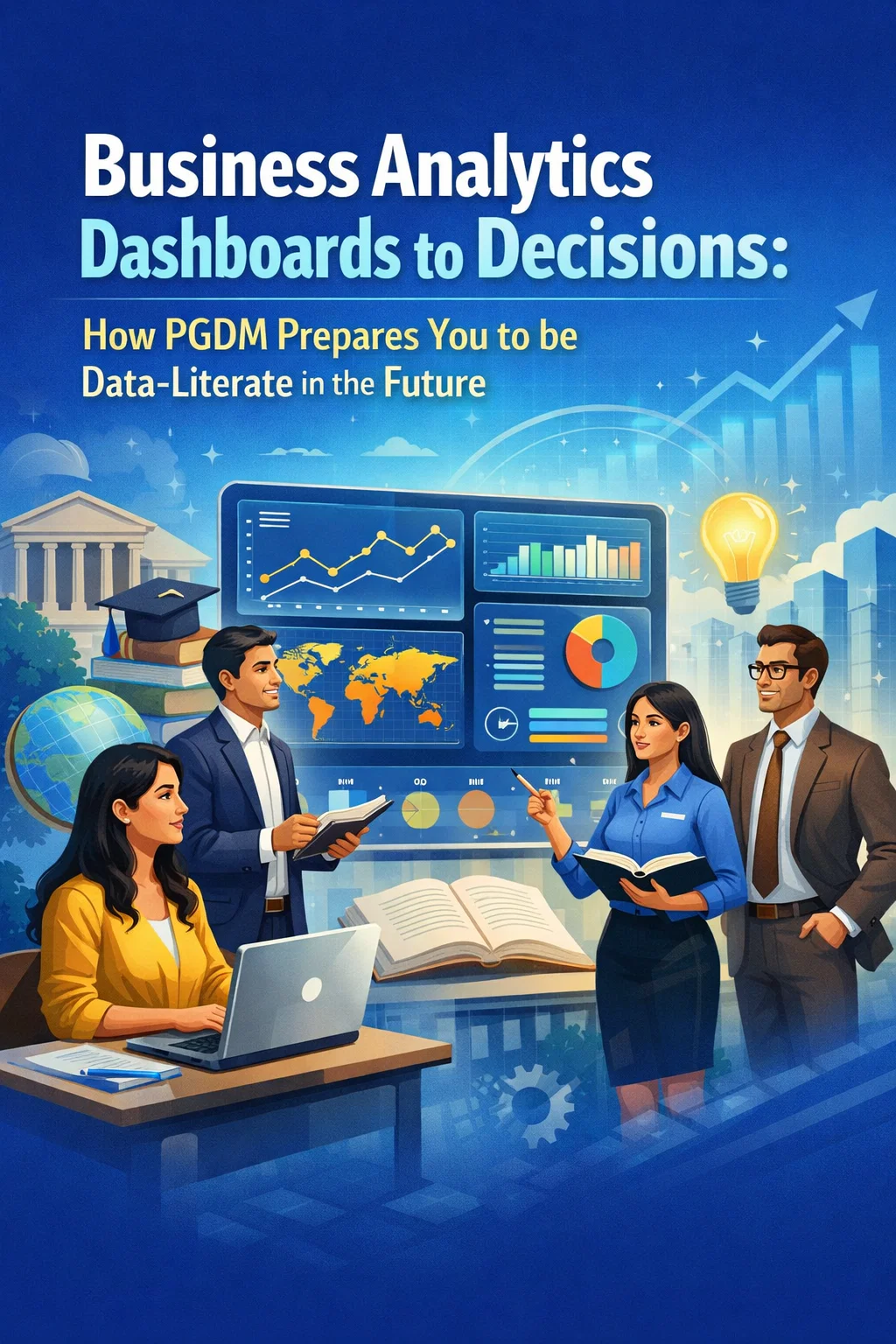
The Data Fluency Revolution
In today’s world, data forms the foundation of any business decision. The information that firms get daily, such as customer behaviour and market trend is monumental. Data fluency refers to the ability to comprehend, interpret, and take action with this information. A PGDM in research and business analytics develops this fluency by teaching students how to handle and analyze data so that they are industry-ready in a data-driven world.
Moving Past Spreadsheets: Unlocking True Data-Driven Decision Making
The use of data in decision-making is not merely about using spreadsheets. It can be defined as the process of extracting actionable information from raw data using advanced analytics. The PGDM in research & business analytics program provides students with the following skills: statistical analysis, predictive modelling, and data visualisation that can transform the business operation and strategies. Such competencies will make future managers tackle complicated business issues with confidence.
Analytics: The Heartbeat of Today’s Businesses
Analytics has become a vital component of organisations. Analytics helps organisations enhance customer experiences, supply chains, marketing strategies, and innovations. By completing PGDM courses in India with a concentration in business analytics, students can be exposed to real-life datasets and analytics tools, including Python, R, and SQL, and this experience provides them with practical knowledge.
Welingkar and other institutions emphasise immersive learning experiences through live projects, case studies, internships, and industry interactions. This is done in PGDM colleges in India so that the gap between theoretical knowledge and practical business requirements can be closed, so that the students can add value to their businesses the minute they are in their professional lives.
The Great Debate: PGDM in Business Analytics vs MBA in Business Analytics
Although both qualifications encompass analytics, a PGDM program is more specialised in techniques and tools of analytics, with a focus on the technical skills required in data positions. MBA courses encompass more general areas such as finance, HR, or marketing management. Therefore, the PGDM in research & business analytics program is typically a better fit for applicants seeking to acquire in-depth analytics skills.
Why Choose PGDM in Business Analytics & Research?
- Dynamic Curriculum: The PGDM in research and business analytics is revised periodically to follow the current trends in the world of technologies: AI, machine learning, big data, and cloud computing. This will equip the students with the tools and techniques applicable to current business challenges.
- Relevant to the industry: The course combines analytics skills with business knowledge, and students are provided with the skills required in managerial positions. Students become skilled in data mining, predictive analytics, data visualisation and business intelligence software, such as Python, R, and Tableau.
- Practical Learning: Institutions like Welingkar focus on experiential learning in the form of live projects, internships and case studies. This practical experience fills the gap between theory and practice, training the ability to think analytically and make decisions that are required in the real world of business.
- Preparation of Leadership: The program promotes problem-solving, communication and critical thinking skills. Graduates are prepared to be team leaders, strategists, and decision-makers who impact business performance.
- High Demand and Career Opportunities: The emergence of data-driven organisations in India has presented enormous opportunities for analytics professionals. A PGDM in Business Analytics opens up positions such as data analysts, business intelligence analysts, marketing analysts, financial analysts, and consulting roles.
- Competitive Advantage: Mastering the art of high-tech analytics and business makes graduates unique in the labour market. They also bring practical knowledge to organizations, which helps them make sound strategic decisions.
- Networking and Industry Relations: PGDM colleges in India offer networking to the industry experts, hence mentorship, internships and placements.
- Ethical & Social Responsibility: The curriculum has incorporated ethical arguments when using data and therefore encourages responsible analytics practices in accordance with societal standards.
- Holistic Development: The program cultivates a global mind, flexibility and durability, equipping the students for the various business contexts.
Also Read – How a PGDM in Business Research & Analytics is Transforming Industry-Wide Decision-Making?
The selection of a PGDM in Research and Business Analytics in a reputed institution will provide students with the necessary technical, managerial, and leadership skills, which will provide a solid base in the data-intensive future of the competitive Indian and global labour markets.
A Curriculum Designed to Build the Analysts of Tomorrow
The general curriculum consists of core and elective courses like Descriptive Analytics, Predictive Analytics, Artificial Intelligence, Data Mining, Cloud Computing, and Social Media Analytics. The program focuses on the certification of leading vendors such as IBM and AWS, which increases employability by certifying major technical skills.
Transforming Insights into Measurable Impact with Analytics
Graduates are taught to transform data insights into meaningful decisions. The analytic aptitudes learnt in optimizing retail inventory or refining marketing campaigns translate into quantifiable business results; hence, such professionals are in high demand in various industries.
The Future is Data-Literate, and It’s Yours to Lead
With organizations on their digital transformation journeys, the need for data-literate professionals is on the rise. PGDM courses in India equip candidates with the ability to assume leadership positions in this data-driven world, which affects strategies and innovations that can impact millions.
Embrace the Future Powered by Data
By selecting a well-known institute such as Welingkar, it is ensured that the student faces high-quality faculty, industry partnerships, new pedagogy, and placement services. This enrichment renders the PGDM in research and business analytics an excellent investment in a bright career.
FAQs
- What is the difference between a PGDM in Business Analytics and an MBA in Business Analytics?
PGDM courses in India are more technical-analytical and focused on tools, as compared to an MBA, which is more comprehensive in management.
- What will be the career prospects of a postgraduate diploma in Business Analytics?
The job roles include a data analyst, a business intelligence analyst, a marketing analyst, a financial analyst, and an analytics consultant.
- How does a PGDM in Business Analytics play a part in developing data-driven decision-making competencies?
Through real-life data, case studies, and working on practical projects, students learn to make useful conclusions and suggest business decisions.