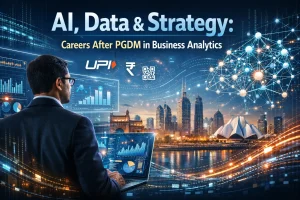

In today’s business environment, decisions no longer rely on instinct alone. Every industry, from finance to marketing and operations to human resources, now revolves around information. Modern organisations generate massive volumes of data through consumer behaviour, digital interactions, and operational metrics. To interpret this data, analyse patterns, and make strategic choices, future managers need analytical thinking and structured decision frameworks.
This is where a PGDM course becomes extremely important. It trains students to understand real business problems, decode information using analytical tools, and make decisions backed by evidence rather than intuition. As companies increasingly value data literacy and measurable outcomes, learning data-driven decision-making has become a defining element of management education.
The Shift: From Guesswork to Clarity
Traditionally, managers depended heavily on experience and assumptions. While experience is valuable, assumptions don’t always reflect market reality. Business decisions based on guesswork can lead to unpredictable results, missed opportunities, or flawed strategies.
Data-driven decision-making offers clarity.
A well-structured PGDM program introduces students to:
- Analytical frameworks
- Business intelligence concepts
- Decision modelling techniques
- Quantitative reasoning
- Real-use case analysis
Instead of making decisions based on what feels right, students learn to evaluate facts, trends, and numbers. For instance, instead of launching a product because it seems promising, managers analyse buyer preferences, spending habits, competitor benchmarks, and projected growth. This approach leads to higher precision and reduces risk.
In short, data transforms decisions from uncertain to strategic.
Driving Business Growth Through Better Data-Driven Predictions
One of the biggest strengths of data-driven learning is predictive insight. Markets move fast, customer preferences shift, and technology evolves. A management professional must be prepared to think ahead, anticipate trends, and plan smartly.
Within a PGDM program, students develop skills such as
- Forecasting consumer demand
- Predicting sales outcomes
- Assessing operational risks
- Planning marketing spends with an ROI focus
- Evaluating new business opportunities
Forecasting models, visualisation dashboards, and statistical analysis teach students how future outcomes can be estimated with accuracy. For example, a marketing student learns how to evaluate campaign performance, measure customer engagement, and identify which platforms generate maximum conversions.
This ability to predict future patterns is what helps companies stay competitive.
Learning Tools Businesses Rely on in Everyday Operations
Modern organisations rely heavily on digital tools for business evaluation, performance tracking, and market insights. A robust PGDM program in Mumbai or anywhere across the country integrates these platforms into classroom learning to reflect real corporate processes.
Some commonly learnt tools & technologies include:
- Excel for business modelling
- Power BI/Tableau for dashboards
- CRM tools for sales pipeline monitoring
- SQL/Data extraction basics
- Marketing analytics platforms
- Project and cost evaluation tools
Students do not just study theory; they use tools to solve real business problems.
A student analysing retail demand might evaluate POS data using Excel and then build category-wise forecasts. Someone planning human resource allocation could use dashboards to visualise performance metrics. Such real-world exposure bridges the gap between classroom learning and corporate execution.
Enhancing Group Work and Collaborative Projects
Team-based assignments are a core part of any PGDM program, and data dramatically improves the quality of those projects. When research is supported by accurate numbers, trend charts, customer surveys, and market analysis, presentations become stronger and more impactful.
Data-driven learning enhances group assignments by:
- Improving clarity during problem-solving
- Structuring research through actual insights
- Enabling performance comparisons with factual benchmarks
- Helping teams justify recommendations with real evidence
- Increasing professional confidence during presentations
Instead of saying “Brand A is growing faster,” students show data charts proving the rate of growth, market share increase, or consumer interest spike. This makes project outcomes professional, measurable, and credible.
Such skills directly translate to internships, workplace discussions, and managerial assignments later on.
Developing the Right Mindset for Effective Corporate Leadership
Data literacy is not just a skill; it is a management mindset.
A strong PGDM course encourages students to:
- Question assumptions
- Validate claims with metrics.
- Solve complex problems with logic
- Interpret information without bias
- Take ownership of the decision
This mindset produces future managers who think independently, analyse situations critically, and respond to challenges with solutions—not assumptions.
Companies prefer leaders who can understand business impact, read performance numbers, and suggest growth plans scientifically. A student graduating with strong analytical thinking enters the corporate world with confidence and readiness.
Why PGDM Colleges in India Prioritise Data-Driven Learning
With industries transforming digitally, PGDM colleges in India are redesigning learning formats to focus on measurable outcomes. The ability to read dashboards, derive insights from raw data, measure revenue performance, and compare market trends is now considered a core managerial requirement.
Institutions strengthen learning through:
- Case-based data simulations
- Research-driven internships
- Data-centric capstone projects
- Industry guest lectures
- Labs for analytical tools and software
The goal is to prepare students for leadership roles, where decision-making is fast, accurate, and responsibility-driven.
Data Is More Than Information – It Guides Decisions
In the modern business ecosystem, data is the strongest competitive advantage. Managers who can analyse and interpret information make better strategies, reduce risks, and accelerate business growth. This is exactly why data-driven decision-making plays a crucial role in every PGDM program today.
From learning business analytics tools to developing predictive thinking and presenting research-backed solutions, students become industry-ready, confident thinkers. Whether you choose a campus-driven experience or a PGDM program from Welingkar Institute, data literacy will remain one of the most valuable takeaways from your management journey.
A PGDM education built on analytical understanding doesn’t just teach management; it shapes future decision-makers.