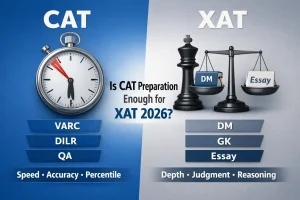
The Xavier Aptitude Test, widely known as XAT, is one of the most competitive MBA entrance exams in India and the gateway to top B-schools. With XAT known for being tougher and more analytical than exams like CAT, candidates must follow a well-structured and intelligent XAT preparation strategy to crack it.
As XAT introduces different sections, like decision-making and essay writing, along with its standard verbal, quantitative, and GK components, candidates need clarity, discipline, and consistent practice. If you plan to appear for XAT 2026, this guide will take you through the right preparation approach, section-wise strategies, timelines, and expert tips to help you perform strongly on test day.
XAT Important Dates 2026 (Tentative)
While the official notification is expected later in 2025, aspirants can track the tentative timeline to plan early XAT preparation:
| Event | Tentative Date 2026 |
| XAT 2026 Registration Opens | July 2025 |
| Registration Ends | November 2025 |
| Admit Card Release | December 2025 |
| XAT Entrance Test Date | 04 January 2026 |
| Results Declaration (tentative) | Last Week of January 2026 |
Starting preparation early, ideally 6–10 months prior, gives you a strong advantage in mastering concepts, building speed, and improving accuracy.
Building a Strong Foundation for XAT 2026 Preparation
To excel in one of the toughest MBA entrance tests, aspirants should:
- Understand the exam pattern thoroughly
- Follow a structured study plan.
- Practise topic-wise as well as mixed-difficulty mocks
- Analyse performance regularly
- Work on weaker areas progressively
With five unique components, XAT preparation for 2026 must be multi-layered and application-based to outperform competitors.
Verbal Ability & Logical Ability
This is one of the most reading-intensive sections, ideal for those with strong comprehension ability. It consists of:
- RC passages
- Critical reasoning
- Grammar-based questions
- Para jumbles
- Vocabulary in context
- Logical structure/Para completion
Preparation Tips:
- Read editorial articles daily to strengthen comprehension.
- Practice RCs on varied philosophical, economic, psychological, and abstract themes.
- Build vocabulary using contextual reading, not just word lists.
- Solve previous years’ XAT papers; they reflect tone and difficulty.
- Focus on reasoning-based verbal questions, not just direct factual comprehension.
Ideal target time: 50–55 minutes with 80–90% accuracy.
Decision-Making in XAT
This is the most distinguishing part of the XAT entrance test. Unlike other exams, XAT tests practical thinking, ethics, and real-world managerial judgement.
Question types include:
- Ethical dilemmas
- Business decision cases
- HR and people management problems
- Prioritisation & resource allocation
- Customer and operational case solutions
How to Prepare Effectively for XAT?
- Read the past 10 years of XAT decision-making sets; concepts repeat.
- Focus on fairness, long-term sustainability, and ethical outcomes.
- Avoid extreme bias and find middle-ground solutions.
- Practice approaching problems logically rather than emotionally.
The target score here creates the cut-off difference. Mastering this section is crucial.
Quantitative Ability & Data Interpretation in XAT
Compared to CAT, Quant in XAT may feel conceptual, analytical, and deeper in mathematics. This section tests problem-solving rather than just speed.
Key chapters include:
- Arithmetic (high weightage)
- Algebra, Functions, Equations
- Geometry & Mensuration
- Number System
- Probability & Permutation
- Data Interpretation sets have lengthy reasoning.
What is the Strategy for High Scoring in XAT?
- Build conceptual clarity before solving advanced-level questions.
- Practise topic-wise for two months, then switch to mixed practices.
- DI solving approach must include approximation, pattern recognition, and calm analysis.
- Accuracy > attempts. Don’t rush. XAT quant rewards correct logic, not guesswork.
Attempt 14–18 quality questions accurately to stay above cut-offs.
General Knowledge for XAT
GK is often ignored, yet it plays a big role in the final merit calculation. This part includes:
- Current affairs (6–12 months)
- Static GK — geography, polity, economy, environment
- Awards, books, personalities, and global news
- Business & finance, mergers, rankings, appointments
Preparation Sources for XAT
- Daily news reading
- Monthly GK magazines & revision charts
- Practise topic-wise quizzes
- Prepare factual lists (countries, currencies, organisations, indices)
The key is consistent revision, not cramming at the last moment.
Essay Writing in XAT Exam
Essay writing, reintroduced recently in XAT, evaluates articulation, depth of thinking, and structured expression. Topics are abstract, case-based, or contemporary.
Expected themes include:
- Ethics, leadership, human behaviour
- Technology & the future of business
- Global economy & sustainability
- Social policy, democracy, innovation
How to prepare essays:
- Read sample essays & editorials regularly.
- Focus on structure — introduction, core argument, balanced counterview, conclusion.
- Use examples, data, and real references to strengthen credibility.
- Practice writing one essay a week for clarity and fluency.
Recommended XAT Preparation Timeline:
| Duration | Goals |
| Feb–Jun 2025 | Build basics + sectional clarity |
| Jul–Sep 2025 | Advanced practice + solve PYQs |
| Oct–Dec 2025 | Mock tests + full-length strategy building |
| Jan 2026 | Revision + final polishing + exam mindset |
FAQs on XAT Exam Preparation
6–10 months of consistent preparation is ideal for strong performance.
XAT is more conceptual and analytical, especially in decision-making and verbal communication. Difficulty is comparable, but the structure differs.
Practice the previous year’s DM sets and think ethically and logically; avoid impulsive solutions and create an XAT preparation strategy.
At least 20–30 full-length mocks with detailed analysis help boost performance.