For most family businesses,the dream of going global isn’t just about expansion—it’s about legacy. It’s about proving that a business built on tradition, loyalty, and relationships can also succeed on the world stage. But international growth comes with a unique set of challenges, especially for family-run firms.
From cultural clashes to governance models and succession stress to geopolitical volatility, globalizing a family business demands more than ambition.
It needs structure, strategy, and above all, a mindset shift especially when transitioning from the 1st generation founders to the 2nd generation or even grooming a 3rd generation to take over.
Here’s a deep dive into how family businesses can successfully navigate international markets, scale responsibly, and build resilience for a global future.
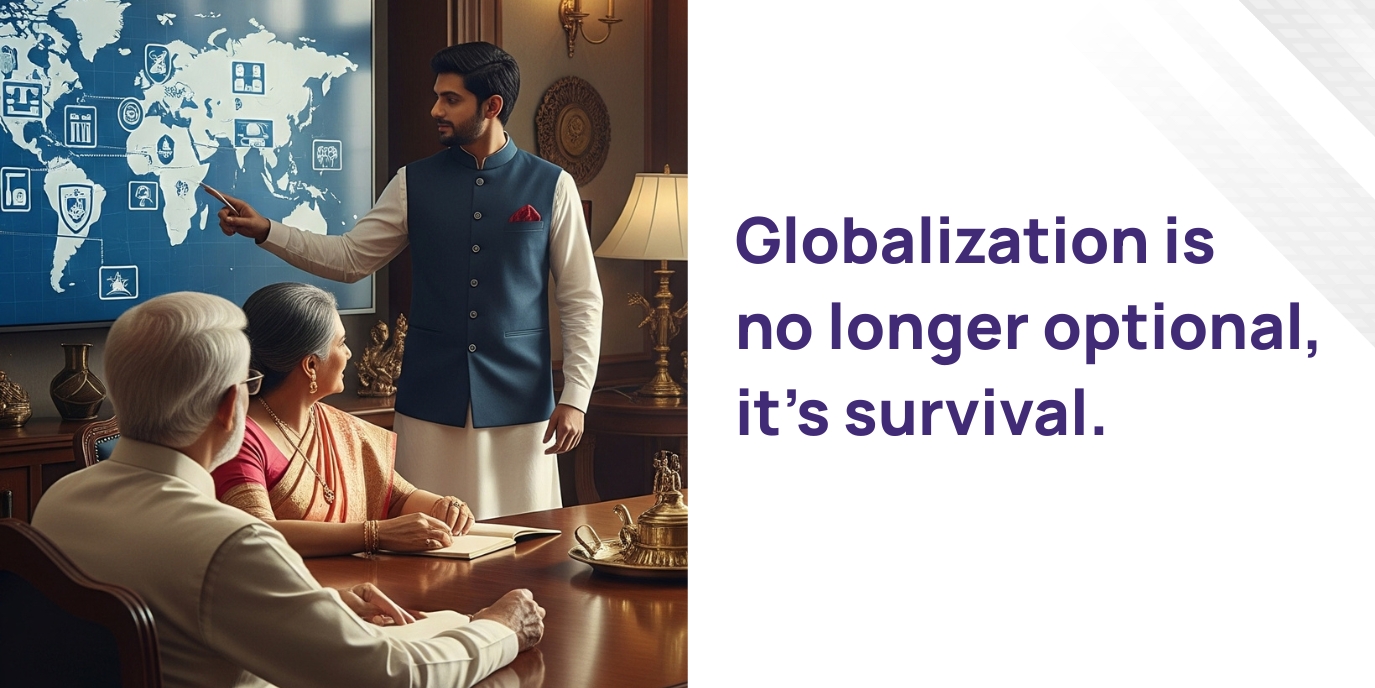
Globalization is no longer optional, it’s survival.
Rapid tech adoption, digital-first customers, and fragmented supply chains have pushed even the most local businesses to explore international opportunities.
And yet, family-owned businesses have often stayed rooted in domestic familiarity. Why?
However, this is slowly changing. Early succession planning is enabling younger generations to step into leadership roles with a global vision. The 2nd generation and 3rd generation heirs are more digitally native and globally ambitious. Studies show that family firms that internationalize smartly often outperform non-family firms in long-term stability, revenue, and resilience because they’re built on trust and long-term vision.
Before you make the leap, understand the hurdles that often derail global ambitions.
Different geographies come with different social codes, values, and compliance frameworks. A casual leadership style might work in the US but fail in Japan. Family businesses must respect local culture while preserving their own identity.
Family-run structures might seem confusing to foreign stakeholders. Investors want transparency, clear succession plans, and data-driven governance. Modernizing management is key before you approach international partners.
Operating across borders means navigating taxation, labor laws, import/export rules, and sometimes even trade wars. Without a robust legal team, compliance gaps can break your business before it scales.
One of the best ways to globalize intelligently is to study successful family businesses that have already done it.
For example:
What do these success stories have in common?

AI isn’t just for startups. It’s a game-changer for family businesses going global.
Top use cases include:
The best-performing family firms led by 2nd generation leaders are now using AI not just for automation but for insight-driven leadership. This allows them to balance legacy wisdom with digital precision.
Your values may be timeless but your messaging must be contextual.
Branding that works in India might need major edits in Germany, Nigeria, or Japan. Avoid translating campaigns directly - translate meaning instead.
Tips for family businesses entering new regions:
A great solution?
Being a family-owned business can actually be a global brand advantage—but only if it’s framed around trust, resilience, and heritage passed down through the 1st generation to the 3rd generation.
Going global changes succession planning. You’re no longer choosing a leader who only understands the local market, they need to be a global operator.
Some best practices:
In today’s world, business transition must be designed with global adaptability, not just domestic continuity.
Think of this as your go-global SOP manual.
It should cover:
This manual keeps future expansion focused and prevents costly trial-and-error, especially during intergenerational business transitions.
Location matters.
Dubai is becoming a go-to launchpad for Asian and African family firms because of:
Similarly, Singapore, the Netherlands, and Ireland are ideal for tech-driven family businesses, while Mauritius and the UAE are often preferred for tax planning and ease of setup.
The future belongs to family businesses that master both their roots and their reach. It’s no longer enough to be respected locally,you must be relevant globally.
But here’s the good news: family businesses have the ultimate edge. They are built on trust, resilience, and long-term thinking - qualities the world needs now more than ever.
Courses like PGPEFMB at WeSchool are designed to help business heirs, entrepreneurs, and next-gen leaders prepare for this future. From early succession planning to governance frameworks and international business strategy, you’ll learn how to take your legacy global without losing what made it special.