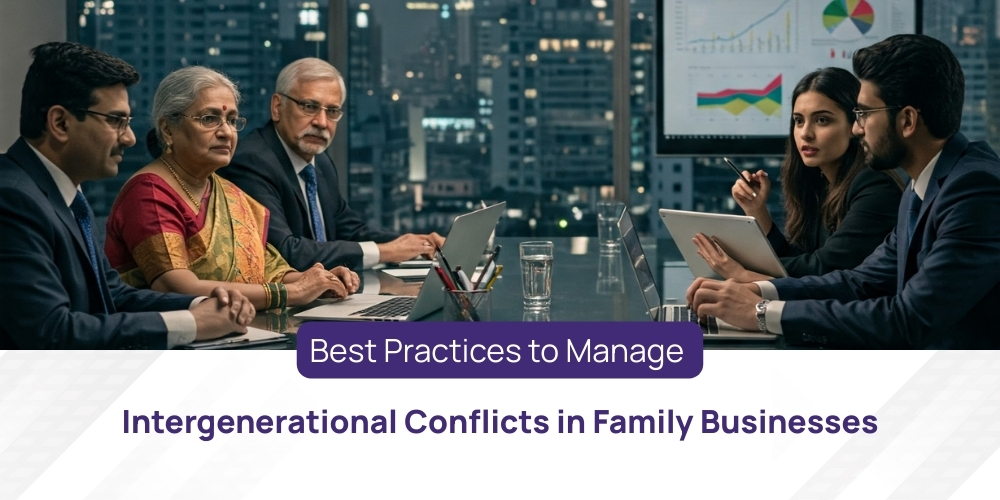
Family businesses often bring together multiple generations working towards a shared vision. While this creates strong legacy and continuity, it also introduces conflicts due to differences in perspectives, values, and management styles.
Intergenerational conflict in family businesses refers to disagreements between different generations (such as founders and successors) due to differences in values, leadership styles, goals, and decision-making approaches.
These conflicts often arise because older generations prioritize stability and tradition, while younger generations focus on innovation and growth.

Conflicts between generations are common in family businesses and often stem from multiple underlying factors.
Family businesses experiencing generational conflict often face:
Managing these conflicts requires a structured and professional approach.
Developing structured management skills through a family business management course can further help in implementing these strategies effectively.
A successful family business finds the right balance between preserving legacy and embracing change. While the older generation brings experience and stability, the younger generation contributes innovation and new ideas.
When both perspectives are aligned, businesses can create a strong foundation for sustainable growth.
Managing intergenerational conflict requires structured knowledge, leadership skills, and strategic thinking.
If you are part of a family business, enrolling in a family business management course or an entrepreneurship course in Mumbai can help you:
Explore the Post Graduate Program in Entrepreneurship Management (FMB) to gain practical insights into managing family business challenges.
1. What causes intergenerational conflict in family businesses?
It is mainly caused by differences in values, leadership styles, communication gaps, and resistance to change between generations.
2. How can intergenerational conflicts be resolved?
By improving communication, defining roles clearly, implementing governance structures, and gaining structured knowledge through a family business management course.
3. Why is intergenerational conflict common in family businesses?
Because family and business roles overlap, leading to emotional and professional disagreements.
4. Can intergenerational conflict be beneficial?
Yes, when managed well, it can lead to innovation, better decision-making, and stronger business strategies.
Intergenerational conflicts are a natural part of family businesses, but they do not have to be detrimental.
With the right strategies and professional approach, these conflicts can be transformed into opportunities for growth and innovation.
To effectively manage such challenges, many professionals choose to upskill through an
entrepreneurship management program
designed specifically for family businesses.